The RP Story
Twenty years, twelve people, one workshop in the Kathmandu Valley — and one rule we have never broken.
Every RP sofa is finished by a hand you could shake.
That sentence is not a slogan we bought from an agency. It is a literal description of how this workshop operates, and it is the only promise on this entire website that we would defend in front of a customer who was angry with us.
How it started
RP Furniture began the way most small manufacturing in Nepal begins: with one man, a rented shed, a set of chisels, and orders that arrived by word of mouth. Jhalak Bahadur Khatri did not set out to build a brand. He set out to make a living, and he discovered fairly early that he was better at making a sofa properly than at making one quickly.
That is a difficult trait in this trade. A sofa built properly costs more and takes longer, and for the first few years that meant losing work to shops that could quote a lower number on the spot. What kept the workshop alive was the second sale — the customer who came back four years later for a second piece, and the cousin they sent, and the landlord who had furnished one flat and then had two more.
Twenty years on, most of what leaves this workshop still goes to somebody who was sent by somebody else. That is a good business to have. It is also a fragile one, because it depends entirely on people who already know you, and it cannot reach the couple in Imadol who moved in last week and are searching on their phone tonight.
What we actually do here
Timber arrives as sal from the Terai and is stacked with spacers in the yard so air moves through it. It sits there for at least a year. Nobody can see this in a finished sofa and it costs money and space, which is precisely why it is the first thing a workshop under price pressure abandons. Green wood contains a great deal of moisture; as that moisture leaves, the timber twists, and a twisted frame is where a permanent creak is born.
Krishna Bahadur Tamang, who has been at the frame bench for nineteen years, cuts and joins every frame. Corners are mortise-and-tenon — a tongue cut on one piece into a socket cut in the other, glued and pinned — not butted and stapled. Every frame is pushed and loaded before it is covered. Frames that rack get taken apart.
Sunita Maharjan cuts every cover from a master template rather than measuring each piece afresh, which is why our sets still look like sets after five years. Bikash Shrestha cuts and layers the foam, fits it, and does the final inspection before anything is wrapped. Dhan Kumar Rai carves the Newari Kala frames — around forty days of chisel work for a single three-seater — and is teaching two apprentices, which is the part of this workshop we would most like to still exist in twenty years.
Twelve people work here. On a busy month we finish between forty and sixty pieces. We are not the biggest workshop in the valley and we have no ambition to be.
The problem we could not solve with better sofas
There is a trust problem in Nepali furniture and everybody in the trade knows it. Search online and you will find video after video of customers who paid an advance for furniture that arrived wrong, arrived late, or did not arrive at all. Search a little further and you will find people warning each other not to buy furniture on the internet in Nepal at all.
We understood that fear because we could not answer it. A customer standing in the workshop, touching a frame, could see everything. A customer on a phone at eleven at night could see only photographs, and photographs are the one thing a dishonest seller can produce most easily.
We tried the obvious answers. Better photographs — which helped the good sellers and the bad ones equally. Longer warranty claims — which anybody can write. Testimonials — which anybody can invent. None of it addressed the actual question the customer was asking, which was not 'is this sofa nice' but 'will you still be here, and will you honour this, in year four'.
The Karigar Ledger
The answer came from the workshop floor rather than from marketing. A customer returned with a photograph of a sofa we had built for her parents, wanting the same one. She could not tell us the fabric, the size or the year. We found it eventually in a paper register, three books back, by matching a delivery address.
While Krishna was reading that register he said something that changed how we work. He remembered building it — the cloth, the customer's father, the week. But his name was nowhere in the book. The register recorded what was sold. It did not record who made it.
So now every sofa carries a label with a serial number and a QR code. Type that number into this website and you see the karigar who built it, the date it was finished, the exact fabric batch, the exact foam specification, and how many days of warranty remain. From the same screen you can reorder the identical fabric, book a care visit, or refer a friend for a two thousand rupee credit. It is not a marketing page — it is our actual production record, opened up to the person who paid for the sofa.
It solves practical problems: matching an extension order two years later, knowing what foam to use for a refill in year six, settling a warranty question with a record instead of an argument. But the reason we are proud of it is the other one.
On naming the maker
In Nepali manufacturing the maker is almost always anonymous. The shop is named, the brand is named, the owner is named. The person whose hands did the work is not. We were asked, fairly, whether putting a karigar's name on a label honours him or uses him, and it is a serious question that deserves a serious answer rather than a warm sentence.
Our position is this. Naming somebody without their consent, without a wage that improved, and without any path forward would be using them. So: every karigar chooses whether their name appears and can take it off at any time. The ledger records the person who actually did the work, not the most photogenic member of the team. On the carved pieces both the carver and the upholsterer are named, because both built it. And the apprentices know exactly what has to be true before their own name goes on a label, which has turned out to matter more than anything we intended.
We are not claiming this fixes how craft is valued in Nepal. It is one workshop, one label, one system. But it is a beginning.
What we would like to happen next
We would like a person in Nepal thinking about a sofa to type our name rather than a category. We would like the karigars here to be known by name outside this building. And we would like the twenty-year-old apprentice at the back bench to still be doing this work in 2046, with his own name on labels, teaching somebody else.
If you want to see whether any of this is true, come to the workshop on a working morning. Nothing will be tidied for you. Push a frame, squeeze the foam, talk to Krishna. Then decide.
Jhalak Bahadur Khatri · RP Furniture · 9849239091
The people whose names go on the label
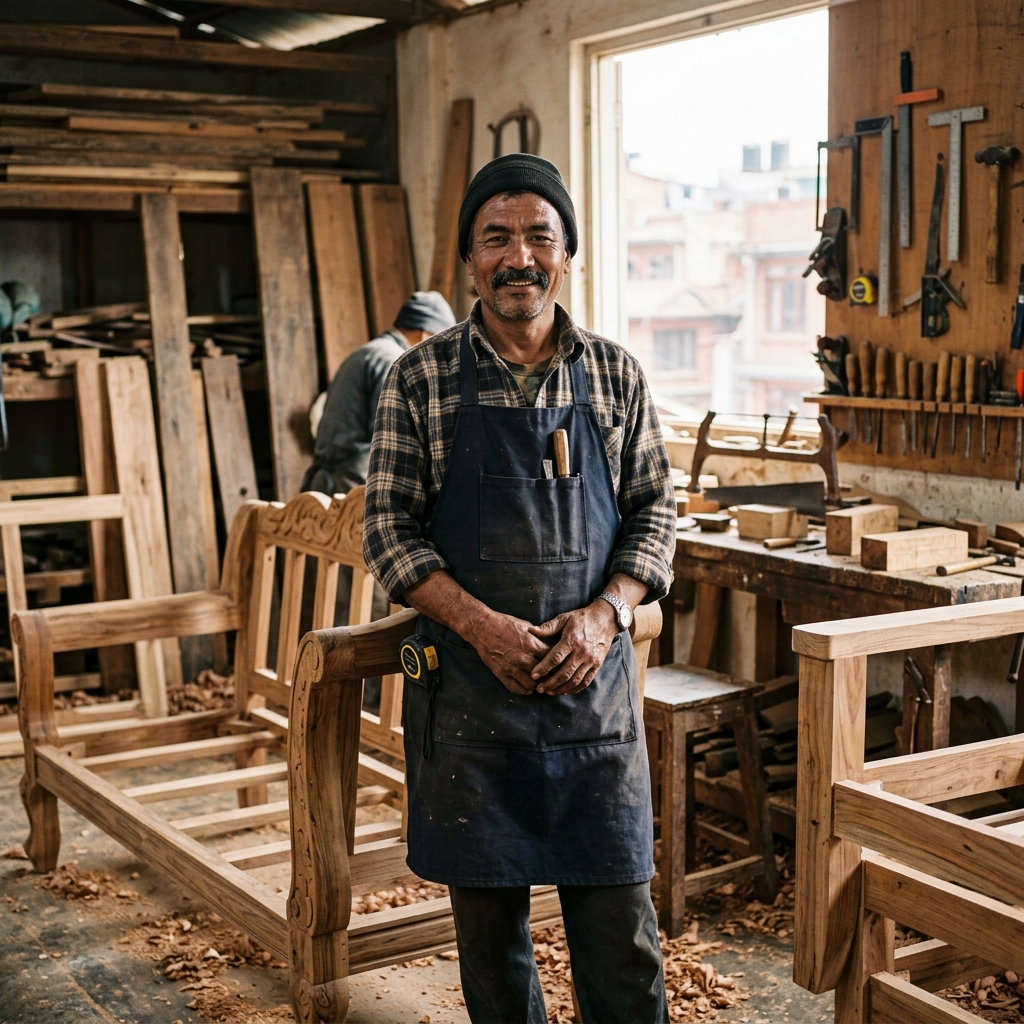
Krishna Bahadur Tamang
Frame maker · 19 years
Krishna cuts and joins every frame that leaves this workshop. He can tell whether a length of sal has been seasoned properly by knocking on it, which sounds like a story until you watch him reject a plank and be right.
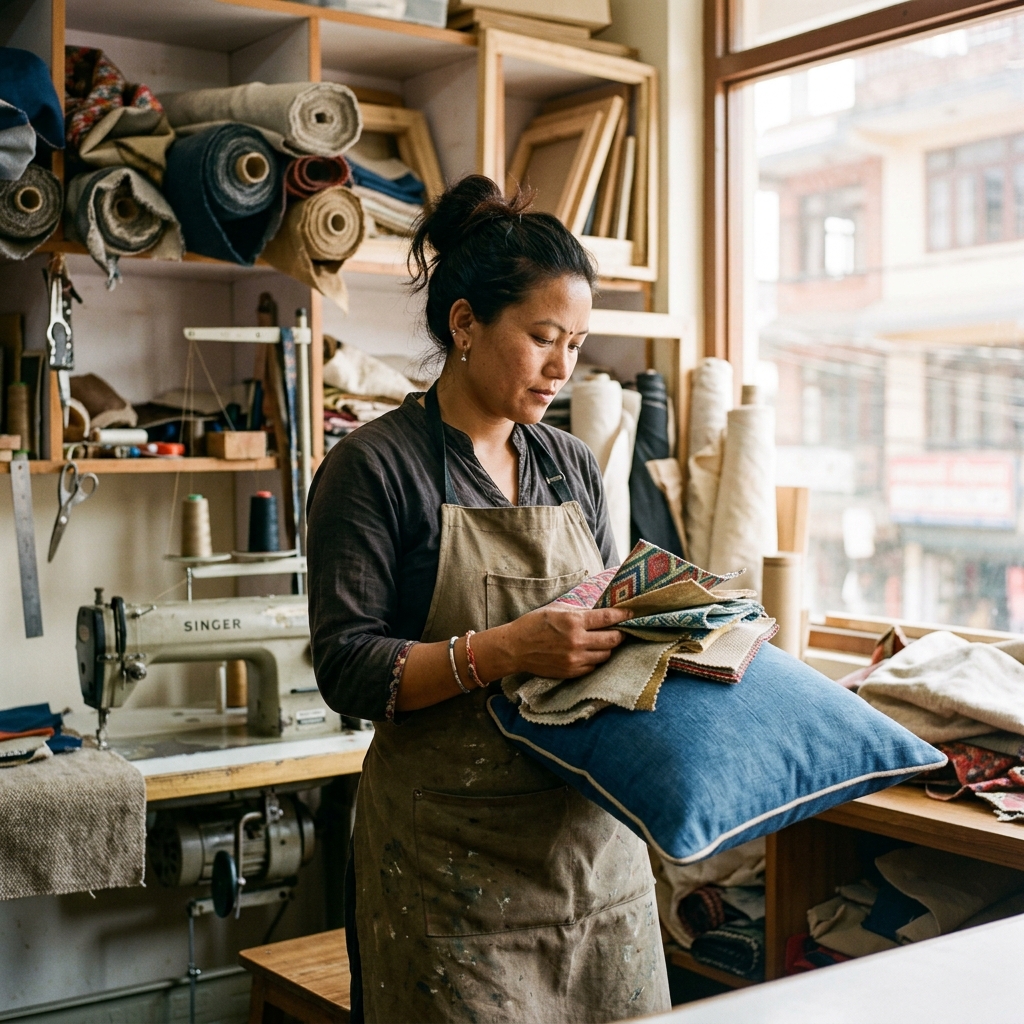
Sunita Maharjan
Upholstery and cutting · 11 years
Sunita cuts every cover from the master template and runs the seams. If you have ever seen a sofa where the seam wanders by half a centimetre over two metres, you have seen work that did not pass her bench.
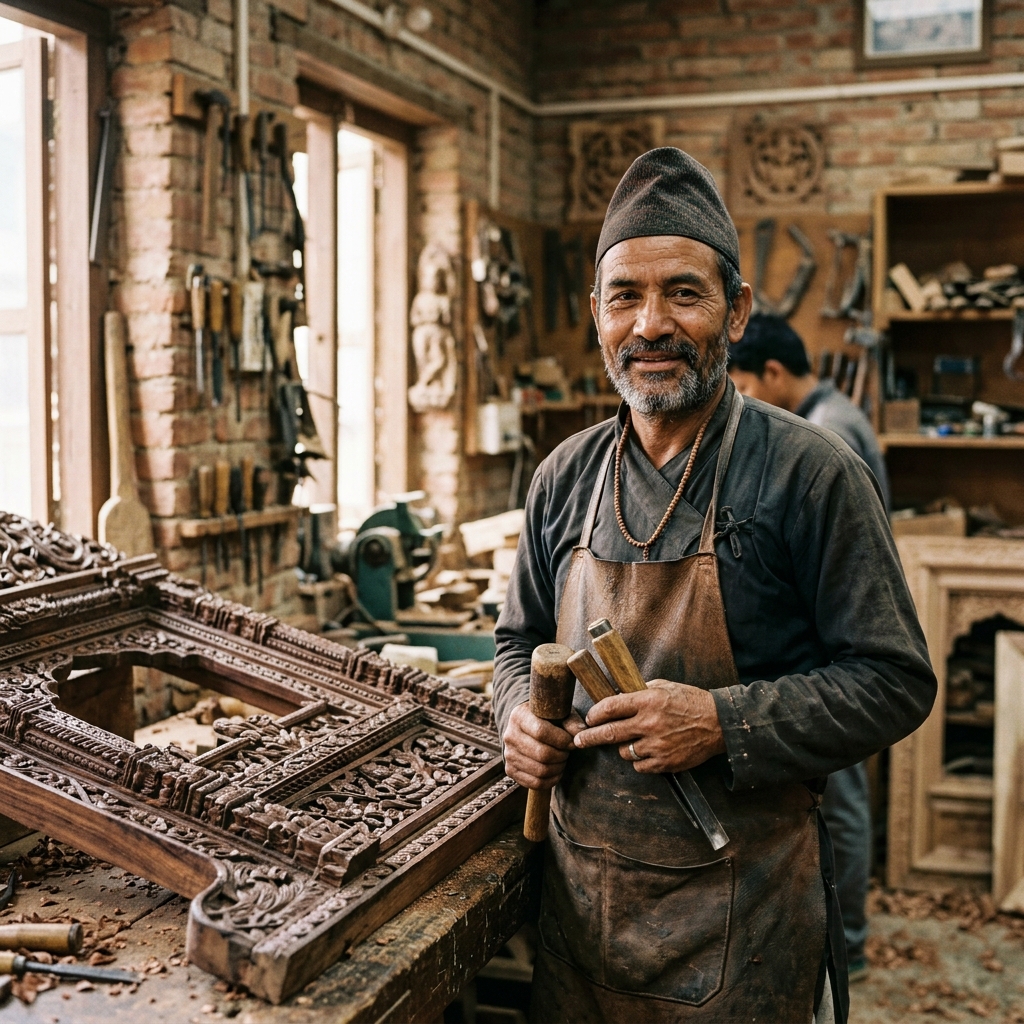
Dhan Kumar Rai
Carving · 23 years
Dhan Kumar carves the Newari Kala frames. A single three-seater frame is around forty days of chisel work. He learned from his father in Bhaktapur and is currently teaching two apprentices, which is the part of this that matters most.
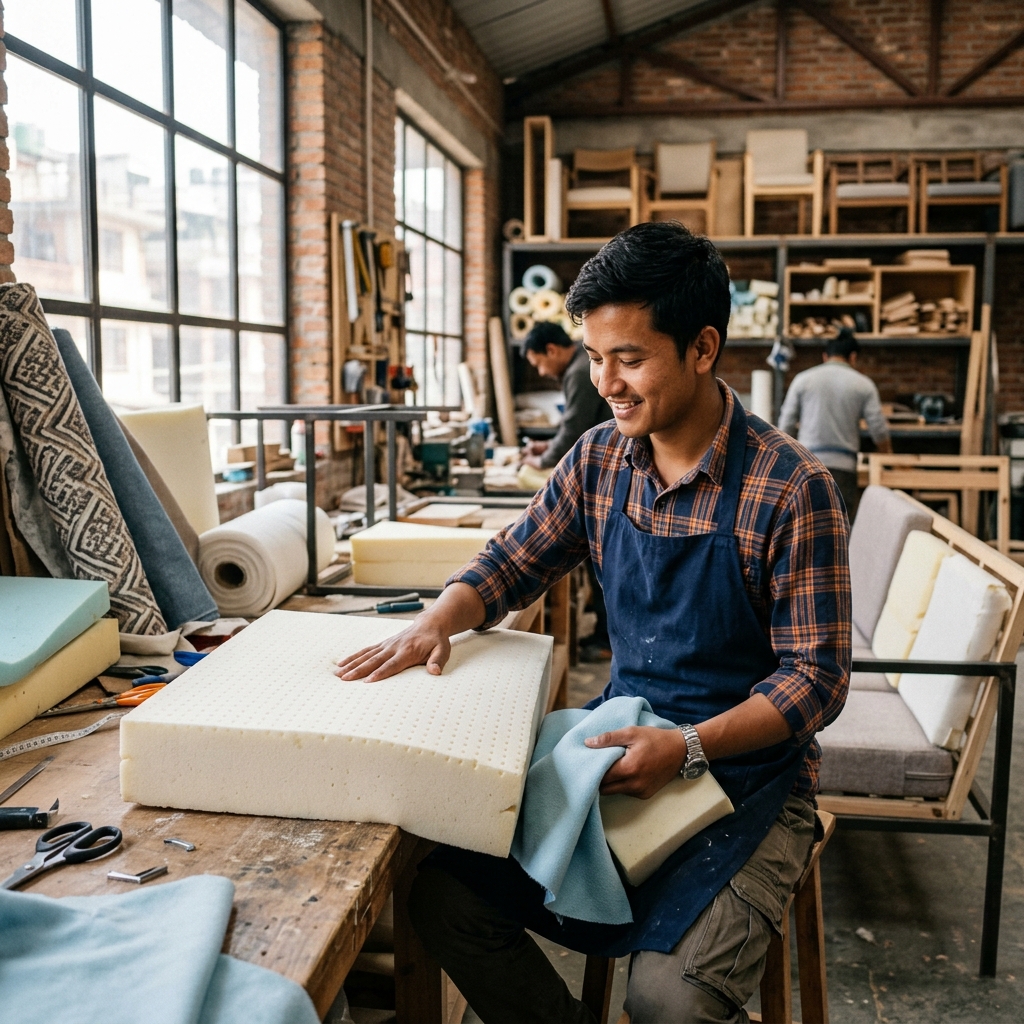
Bikash Shrestha
Foam, fill and finishing · 7 years
Bikash cuts and layers every cushion and does the final inspection before a sofa is wrapped. His name appears on most of the labels in the Karigar Ledger because his is the last pair of hands on the piece.
Every karigar chooses whether their name appears on a sofa, and can take it off at any time.